Ask a supplement brand what vitamin B6 does and you will get one of two answers. Either a paragraph of adjectives, or three sentences that sound oddly stiff. The stiff ones are the legal ones. This post explains where they come from, why they are worded the way they are, and why kip prints exactly three of them and nothing else.
What does vitamin B6 do?
Here are three authorised vitamin B6 claims. Vitamin B6 contributes to the reduction of tiredness and fatigue. Vitamin B6 contributes to normal psychological function. Vitamin B6 contributes to the normal functioning of the nervous system.*
Those three sentences are not ours. They are lifted, word for word, from the list of authorised health claims that applies in Great Britain. The register holds a few more for vitamin B6, on things like energy metabolism and the immune system, and we could print those too. We chose three because three is what fits on a tin lid and what we think is worth saying. If you want the rest, the register is public.
What is an authorised health claim?
In Great Britain, any sentence on a food or supplement that links an ingredient to a function of the body is a health claim, and a health claim may only be made if it is on the GB nutrition and health claims register. The register is maintained by the Department of Health and Social Care and, in its own words, "sets out all authorised and rejected nutrition and health claims." The rule underneath it is short: only authorised claims in the register may be used in Great Britain. It was last updated on 19 May 2026.
Each claim on the register was assessed on evidence before it was authorised. The brand does not get to decide whether the science is good enough. Either the sentence is on the list, or it cannot go on the label, the website, the advert, or this blog.
Why "contributes to" and not "boosts"
The vitamin B6 claims we use have the same phrase: contributes to. That is deliberate, and it is the part brands most want to change. The Department of Health published a set of principles on how far the wording can be adapted. A brand may rephrase for grammar or flow, but the adapted wording must not "alter the meaning or strengthen the claim." Swapping "contributes to" for "boosts", "supports your", "fights" or anything implying prevention or treatment turns an authorised claim into an unauthorised one.
We took the simplest route and did not adapt the wording at all. What is on the register is what is on the tin.
What has to sit next to the claim
A claim on its own is not compliant. The regulation that governs claims says a health claim must be accompanied by a statement on the importance of a varied and balanced diet and a healthy lifestyle, the quantity and pattern of consumption needed, a statement to anyone who should avoid the food where that applies, and a warning where a product could be a risk if taken to excess.
That is why every page on this site has the same footer line, and why the tin carries it too: food supplements should not be used as a substitute for a varied, balanced diet and a healthy lifestyle, one pouch at a time, not for under-18s, not during pregnancy or breastfeeding without medical advice. It is not boilerplate we added for cover. It is the other half of the claim.
The same article of the regulation has one more rule worth knowing. A vague reference to general wellbeing is only allowed if it sits next to a specific authorised claim. So a tin that says "for your wellness" with no authorised claim underneath is breaking the rule twice.
Why kip is allowed to make the claims at all
Being on the register is not enough. Every vitamin B6 claim carries a condition of use: it "may be used only for food which is at least a source of vitamin B6." A "source of" a vitamin means at least 15% of its nutrient reference value, and the reference value for vitamin B6 is 1.4mg.
kip contains 0.7mg of vitamin B6 per pouch. That is 50% of the reference value, comfortably past the 15% line, so the condition is met and the three claims are ours to print. The full workings, and the reason magnesium on the same label gets no claim at all, are in every dose on the tin.
What we will not say
Everything above is about vitamin B6, and it stops there. kip also contains L-theanine, chamomile and lemon balm, and there is no authorised claim on the register for any of them that we can use. So we print the amounts and say nothing about what they do. If you have read anything about those ingredients elsewhere, that is your reading, not our claim.
The same applies to the product as a whole. kip is a nicotine-free pouch for the end of the day. That is a description of when people use it, not a claim about what it does to you. We would rather be the tin that says less and means it.
The label, per pouch
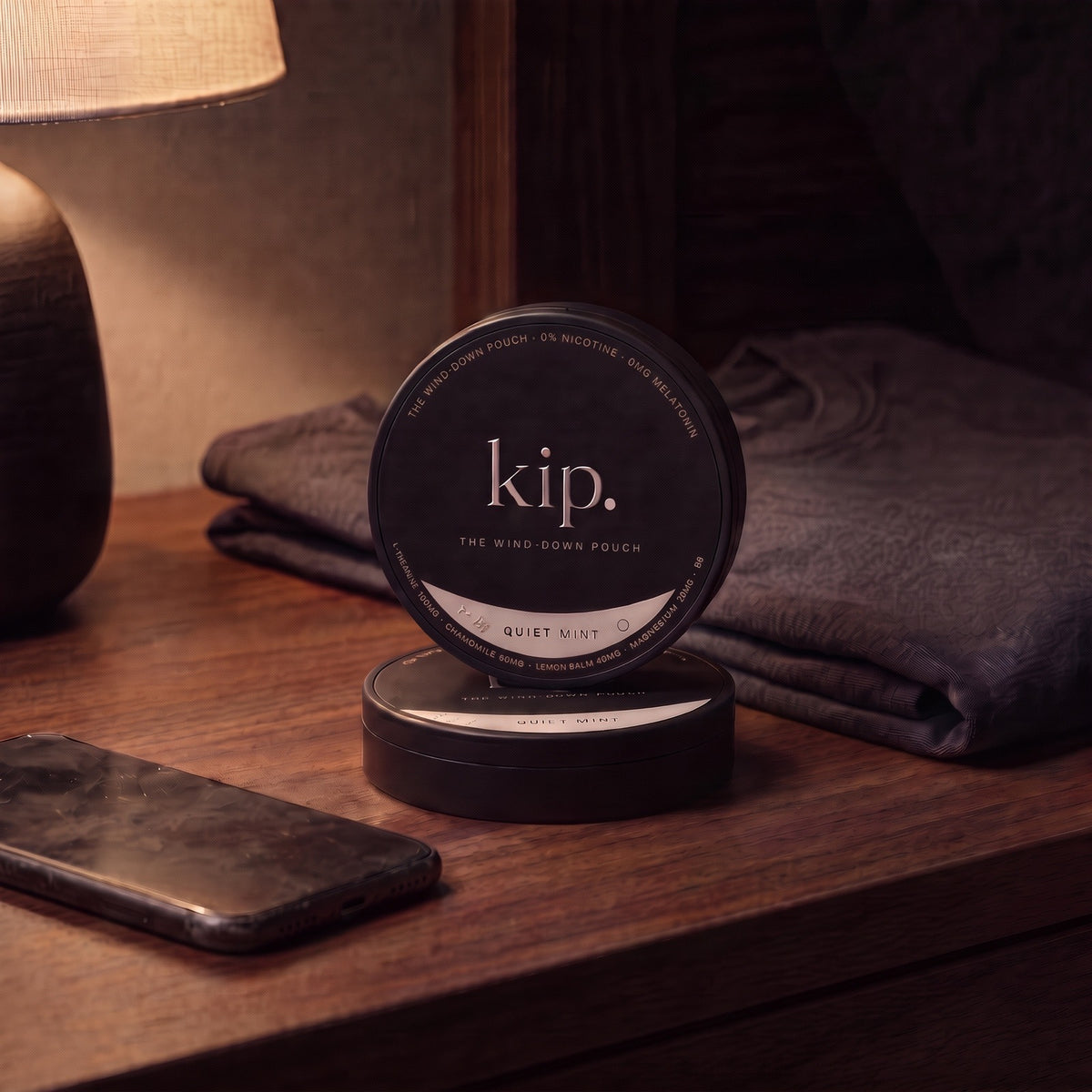
- L-theanine, 100mg.
- Chamomile extract, 60mg, standardised to 1.2% apigenin.
- Lemon balm extract 10:1, 40mg.
- Magnesium bisglycinate, 20mg compound weight, not elemental magnesium. No claim made.
- Vitamin B6, 0.7mg, 50% NRV. Vitamin B6 contributes to the reduction of tiredness and fatigue, to normal psychological function, and to the normal functioning of the nervous system.*
0mg nicotine, 0mg melatonin, no caffeine, no sugar. The full label is on the product page. If the melatonin line raises a question, this post answers it, and if the format is new to you, nicotine-free pouches, explained is the place to start.
Sources
- Great Britain nutrition and health claims (NHC) register, Department of Health and Social Care, updated 19 May 2026.
- Retained Regulation (EU) No 432/2012, Annex: the authorised vitamin B6 claims and their conditions of use.
- Retained Regulation (EC) No 1924/2006, Article 10: the statements that must accompany a health claim.
- General principles on flexibility of wording for health claims, Department of Health, 19 December 2012.
- Retained Regulation (EU) No 1169/2011, Annex XIII: nutrient reference values and the 15% significant amount.
All read on 11 September 2026. If the register changes, this page will.
*GB authorised health claims. Food supplements should not be used as a substitute for a varied, balanced diet and a healthy lifestyle. kip is for adults 18 and over. Not for use during pregnancy or breastfeeding without medical advice.