Most evening routines fail for a boring reason. They rely on deciding, every night, to do the thing. A routine that needs willpower at 10pm is a routine that will lose to whatever is on the screen. The ones that hold are the ones that run on their own, in the same order, with a fixed point that means "done." Here is how to build one, with the only two facts you need.
A sequence, not a list
A list of good evening habits is useless because it asks you to choose. A sequence asks nothing. Same steps, same order, same trigger. The trigger can be anything you already do without thinking: locking the back door, the last plate in the dishwasher, the dog's last walk. Repeating a short sequence can make it more familiar. There is no fixed two-week timetable, and people differ.
Keep it short. Three or four steps. Anything longer is a list again.
The caffeine cut-off
This is the one number worth knowing. The half-life of caffeine in an average adult is about five hours. That is the time it takes your body to clear half of a dose. So a coffee at four in the afternoon still has roughly half its caffeine in circulation at nine, and a quarter at two in the morning.
What you do with that is up to you. People differ in how they respond to caffeine. The point is not a rule, it is arithmetic: whatever time you want to be clear of it, count back five hours for half, ten for a quarter.
Screens and the "one more" problem
The trouble with a phone at the end of the day is not the light, or not mainly. It is that every app is built to offer one more thing. There is no natural end. One practical option is physical: the phone goes somewhere that is not the bedroom, at a fixed step in the sequence, and it stays there. Charging it in another room is one way to put a clear end to scrolling.
A marker for done
The step that makes the rest hold is the last one. It should be physical, a thing you do with your hands rather than a thought, and it should happen at the same point every night. For some people it is a cup of something. For some it is the lamp. For a lot of the people who write to us, it is a pouch.
That is not a claim about what the pouch does. It is an observation about what people use as the full stop. A pouch takes a set time, 30 to 45 minutes, and then it goes in the bin, which gives the end of the day a clear edge. The people who use one that way tend to already have it in their routine from daytime use; the only thing they change at night is which one.
Where kip fits
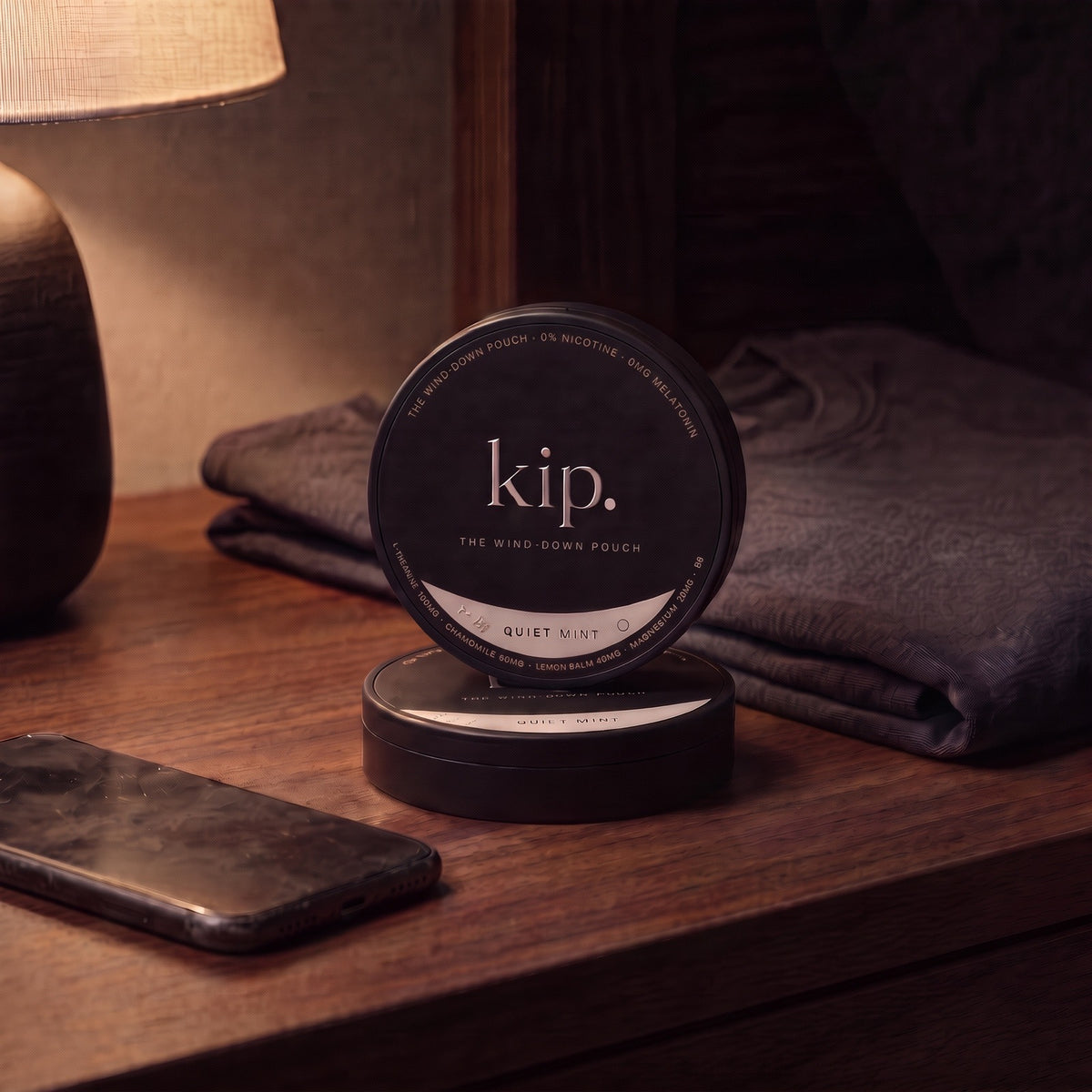
kip is a nicotine-free pouch made for that last step. Same format, 0mg nicotine, 0mg melatonin, Quiet Mint, every dose printed on the tin. kip is a food supplement, with no nicotine or tobacco. It can be an optional marker in this routine. We do not claim it does anything else, because there is no authorised claim we could make, and we would rather say less than say something the rules do not allow.
If the last pouch of your night currently has nicotine in it, the last pouch of the night is about exactly that. If you have never used a pouch, nicotine-free pouches, explained covers the basics. The full label is on the product page.
A routine to try, as a template
- Last caffeine by early afternoon. Count back from when you want to be clear.
- Trigger: a thing you already do at the same time every night.
- Phone to its charger in another room.
- A physical marker for done. Thirty to forty-five minutes, then the bin.
Four steps to adapt to your own evening.
Sources
- StatPearls, "Caffeine", National Library of Medicine: half-life of caffeine in the average adult is approximately five hours.
Nothing here is medical advice. kip is a food supplement for adults 18 and over. Vitamin B6 contributes to the reduction of tiredness and fatigue and to normal psychological function. GB authorised health claim. Food supplements should not be used as a substitute for a varied, balanced diet and a healthy lifestyle. Not for use during pregnancy or breastfeeding without medical advice.