Turn a supplement tin over and one of two things is on the back. Either a list of ingredients with a number next to each, or a word like "blend" with one number next to the whole lot. The difference is not cosmetic. It decides whether you know what you are taking. This post is about that difference, the rules behind it, and why kip's label looks the way it does, including the one ingredient that sits there with no claim next to it.
What is a proprietary blend?
The term comes from American labelling law. Under the US rules for dietary supplements, a maker can group ingredients under a name, "Botanical Blend", "Ingredient Mix", whatever they like, list the ingredients inside it in descending order by weight, and declare only the total weight of the blend. Not the amount of each ingredient. Just the sum.
So a label reading "Night Blend 500mg: chamomile, lemon balm, L-theanine" tells you three things are in there, that chamomile is the heaviest, and that together they weigh half a gram. It does not tell you whether the L-theanine is 200mg or 2mg. That is the point of the format, and it is legal in the United States.
Is a proprietary blend allowed in the UK?
Not in the way it is used in the US. The Food Supplements Regulations 2003 say the label must give the amount of any vitamin, mineral or other substance with a nutritional or physiological effect, in numerical form, per daily portion, as an average based on the manufacturer's own analysis. Each substance, each amount.
In practice you will still see blend totals on tins sold here, usually imports or products written for the US market first. If the amount per pouch, capsule or scoop is not next to each ingredient, the label is not doing what UK rules ask of it. That is worth knowing before you buy.
What does NRV mean?
NRV stands for nutrient reference value. It is the daily figure for each vitamin and mineral that food labelling law uses as a yardstick, set out in an annex to the retained food information regulation. Two that matter here: vitamin B6 has an NRV of 1.4mg, and magnesium has an NRV of 375mg.
The percentage you see next to a vitamin on a label is simply the amount in the product divided by the NRV. It is not a target and not a limit. It is a comparison.
The 15% rule
This is the line that decides everything else. The same regulation defines a "significant amount" of a vitamin or mineral as 15% of its NRV, per 100g or 100ml, or per portion where the pack is a single portion. For a supplement, that is judged on the recommended daily portion.
Two things hang off that number. First, you may only describe a food as a "source of" a vitamin or mineral if it contains at least a significant amount. Second, every authorised health claim for a vitamin or mineral carries a condition of use, and for vitamin B6 it reads the same on all of them: the claim "may be used only for food which is at least a source of vitamin B6."
So below 15% of the NRV, a maker cannot say "source of", and cannot print any health claim for that ingredient at all. Above it, they can use the authorised wording and nothing else.
Why magnesium sits on our label with no claim
kip contains 20mg of magnesium bisglycinate per pouch. That is the weight of the compound, which includes glycine; it is not 20mg of elemental magnesium. An NRV percentage must use the elemental amount, so dividing 20mg by the magnesium NRV would give a misleading result.
We make no magnesium health claim. The elemental amount needs to be confirmed from the ingredient specification and final label review. We do not publish a magnesium NRV percentage based on the compound weight.
Why vitamin B6 does get a claim
kip contains 0.7mg of vitamin B6 per pouch, which is 50% of the NRV. That clears the 15% line comfortably, so the authorised B6 claims are available to us. We use two, in the exact wording from the register: vitamin B6 contributes to the reduction of tiredness and fatigue, and vitamin B6 contributes to normal psychological function.* The asterisk points to the footer line about food supplements and a varied diet, which the rules also require. We do not paraphrase the claims, add adjectives to them, or imply anything beyond them.
What about L-theanine, chamomile and lemon balm?
Nothing, and that is deliberate. There is no authorised health claim we can use for any of them in Great Britain, so the label gives the amount and the form and leaves it there: L-theanine 100mg, chamomile extract 60mg standardised to 1.2% apigenin, lemon balm extract 10:1 at 40mg. If you see a UK tin telling you what those ingredients do for you, the maker is either relying on a claim that does not exist or hoping nobody checks.
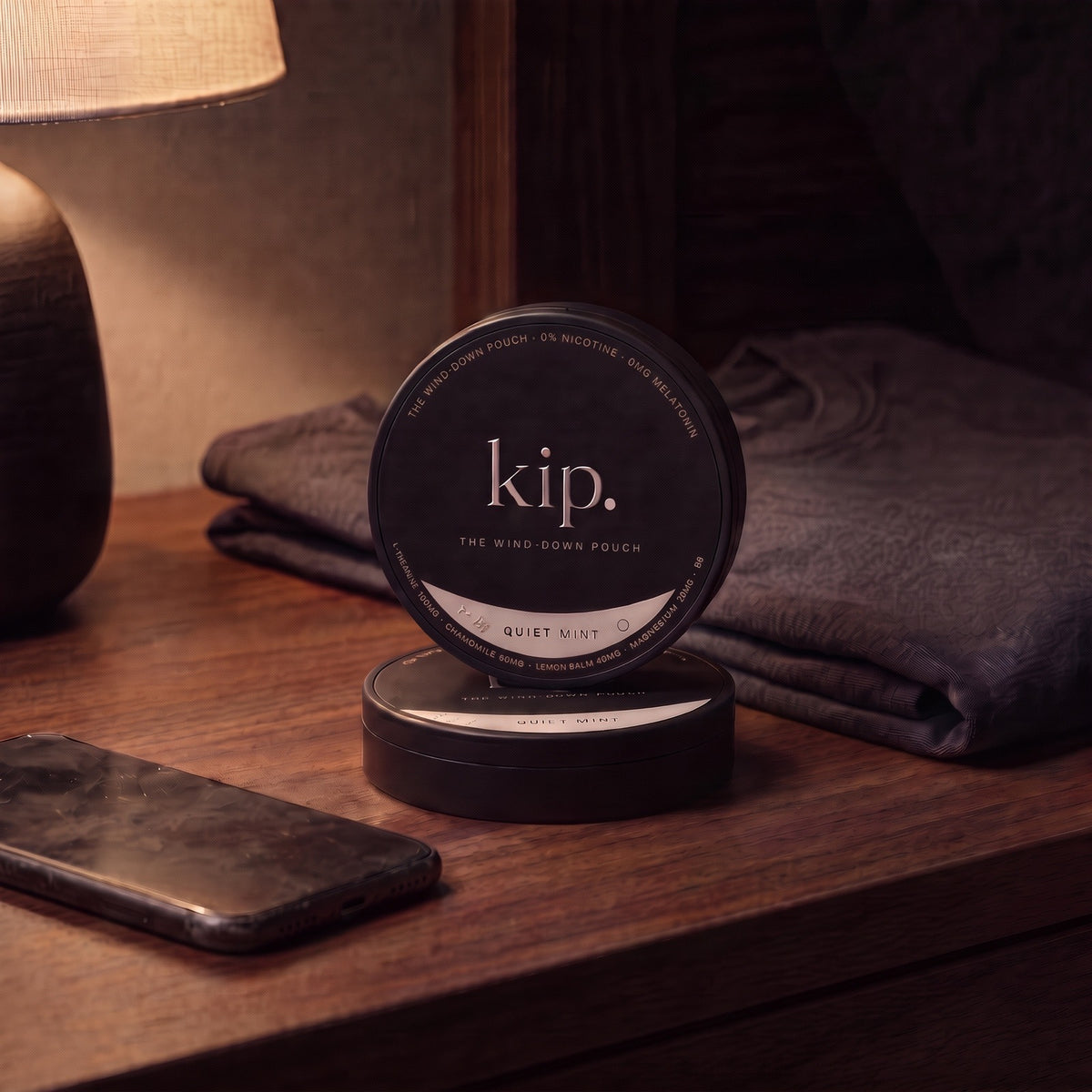
The full label, per pouch
- L-theanine, 100mg.
- Chamomile extract, 60mg, standardised to 1.2% apigenin.
- Lemon balm extract 10:1, 40mg.
- Magnesium bisglycinate, 20mg compound weight, not elemental magnesium. No claim made.
- Vitamin B6, 0.7mg, 50% NRV. Vitamin B6 contributes to the reduction of tiredness and fatigue and to normal psychological function.*
0mg nicotine, 0mg melatonin, no caffeine, no sugar. 20 pouches to a tin, one pouch per use, 30 to 45 minutes, then bin it. Made in a UK factory. The same list is on the product page, and if the melatonin line raises a question, this post answers it. If the format is new to you, nicotine-free pouches, explained is the place to start.
Sources
- US Code of Federal Regulations, 21 CFR 101.36(c), on proprietary blends.
- The Food Supplements (England) Regulations 2003, regulation 6.
- Retained Regulation (EU) No 1169/2011, Annex XIII: nutrient reference values and the definition of a significant amount.
- Retained Regulation (EC) No 1924/2006, Annex: conditions for "source of" claims.
- Retained Regulation (EU) No 432/2012, Annex: authorised health claims for vitamin B6 and their conditions of use.
All read on 11 September 2026. If a rule changes, this page will.
*GB authorised health claims. Food supplements should not be used as a substitute for a varied, balanced diet and a healthy lifestyle. kip is for adults 18 and over. Not for use during pregnancy or breastfeeding without medical advice.